|
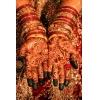 The application of Mehndi as an art. Apart
from clothes and jewellery, currently one can use colours on one's very skin as
a way of exposing one's personality. The most familiar form of body art is the
use of Mehndi. Mehndi or henna is a flowering plant whose leaves are used to
dye skin, hair, fingernails, leather, silk and wool.
The application of Mehndi as an art. Apart
from clothes and jewellery, currently one can use colours on one's very skin as
a way of exposing one's personality. The most familiar form of body art is the
use of Mehndi. Mehndi or henna is a flowering plant whose leaves are used to
dye skin, hair, fingernails, leather, silk and wool.
The use of Mehndi in the
Indian sub-continent's culture is a sign of a joyous occasion, such as Diwali,
Eid, New Year celebration, wedding, engagement and so on.
History of Mehndi
Mehndi is thought to have been brought to
India by the Mugals in 12 A.D. after it had been used for centuries in the
Middle East and Africa. Some of the earliest documentation says Mehndi comes of
ancient Egypt, where it was used as a dye to stain the fingers and toes prior
to mummification.
Only in the 20th century the beautiful
pattern common in India today has come out. In 17th century India, the barber's
wife was usually employed for applying henna on women. Most women from that
time in India used to colour their hands and feet with Mehndi irrespective of
social class or status.
Origin of Mehndi
Mehndi originates from a bush called
Lawsonia Inermis grown in the Sudan, Egypt, India, most of the North African counties
and the Middle East also.
The bush also grows quite larger in Florida
and California that ranges from six to twenty feet. Mehndi or henna comes in
many different shades or colours, ranging from reddish orange to brown-black.
Other colours available are usually artificially mixed and have dyes added to
the natural Mehndi, these usually do not last as long as natural Mehndi.
Natural ones can last for anything between
1-2 weeks depending on the number of times the coloured area is washed and on
the body temperature.
Mehndi designs
Traditionally there are four separate
styles of Mehndi designs. The Middle Eastern style similar to the Arabic
textiles, paintings and carvings is mostly made up of floral patterns.
Generally the North African style shapes
the hands and feet using geometrical floral patterns.
Lastly, the Indonesian and Southern Asian
styles are formed with a mix of Middle Eastern and Indian designs using blocks
of colour on the very tips of their toes and fingers.
In Bangladesh, are most popular because of
being thin, prominent and elaborate Pakistani designs are very popular in
Bangladesh, which are a blend of the
north Indian style and Arabic motifs - flowers, leaves and geometrical shapes.
Apart from these styles remain popular
today Celtic designs and Chinese symbols have also been joined in popularity.
Mehndi customs
In India, Pakistan and Bangladesh today
wedding is celebrated in a much larger canvas than before. Mehndi occupies a
significant mainstay in all parts of a wedding ceremony in all Eastern wedding
traditions. No wedding is complete
without the decoration of the bride's hands and feet as traditionally, Mehndi
designing for any Indian sub continent's bride is a must event.
Traditionally brides get together with her
friends and spend hours applying the henna to her skin to mark the day special.
There is an interesting reason for the bride for using Mehndi that she is not
likely to join in household work until the henna is gone.
A blessing of mother-in-law is important to
Asian brides of many cultures. Mehndi ceremony is sacredly considered as a symbol
of blessing for the bride's married life. That's why the ceremony cannot move
ahead unless the mother-in-law has applied the first spot of Mehndi to the
bride's hand. Besides, the bridegroom's hands are also decorated in some
customs and communities in Kashmir and Bangladesh evolving particular designs
for men. Mehndi is also used in weddings and other special occasions that
include worship and work.
Mehndi in different countries
In the Gulf regions including Saudi Arabia,
Bahrain, Kuwait and the United Arab Emirates Mehndi night is a very common
phenomenon.
A few days prior to the wedding they celebrate
the Mehndi night like the Indian culture. The brides decorate her hands and feet and mothers
and grandmothers sing traditional songs making the night enjoyable and
memorable.
Mehndi is also used in other Middle Eastern
celebrations such as births and christenings. Mehndi decorations became chic in
the Western countries in the late 1990s. Western communities have adopted many
wedding traditions of Eastern countries incorporating the application of Mehndi
on hands and feet, the great Indian way. Apart from the similar use of Mehndi
It has also become a business in the developed world.
Other use of Mehndi
Mehndi is considered as short-term tattoo,
which is totally safe as it is made of all natural ingredients. It only
lasts for a few days.
Mehndi is served as symbols of status,
religious significance, marks of fertility, pledges of love, talismans for
protection, and marks of slaves and convicts.
Now- a-days Mehndi has broken free of the
traditional wedding and is being applied for different occasion like worldwide Valentine's
Day bash, celebration of new year and in others joyful occasion.
Hands decorated with Mehndi arrest the
attention of lovers. It's a symbol of love. Mehndi is also an excellent
conditioner for hair and used to colour premature grey hair. It is also applied
on the head to stop hair loss. There is also medical use of Mehndi as many
herbal doctors still recommend the use of Mehndi for some ailments such as dry
skin.
Conclusion
The age-old typical Indian custom and an
essential part of brides' makeup, Mehndi has created global appeal. Now ready-made
Mehndi is readily available from most shops in most countries with different
designs. Mehndi usually stays on the body for fifteen to twenty days,
varying with the body heat of each individual. It fades gracefully.
|